Social Feed Generation at Scale: 100 Shorts a Week
Template banks, prompt queues, review batches. How to keep quality up as volume goes up.
Social Feed Generation at Scale: 100 Shorts a Week
There is a wall you hit at roughly 20 shorts a week. Up to that point you can hand craft every prompt and review every clip. Above that point your review inbox becomes a second job, your quality drifts, and your costs get irregular. The teams that publish 100 a week are not working harder. They rebuilt the pipeline.
Here is what the rebuild looks like.
Templates, not prompts
The first rule at volume is that prompts are not the unit of work. Templates are. A template is a prompt skeleton with typed slots. Something like "a {product} in a {environment}, captured in {camera_move}, lit by {lighting_mood}, {time_of_day}". Your prompt queue populates those slots from a CSV or a small database.
Ten templates covering your most common shot types handle about 80 percent of weekly volume. The remaining 20 percent is where you write custom prompts for hero moments.
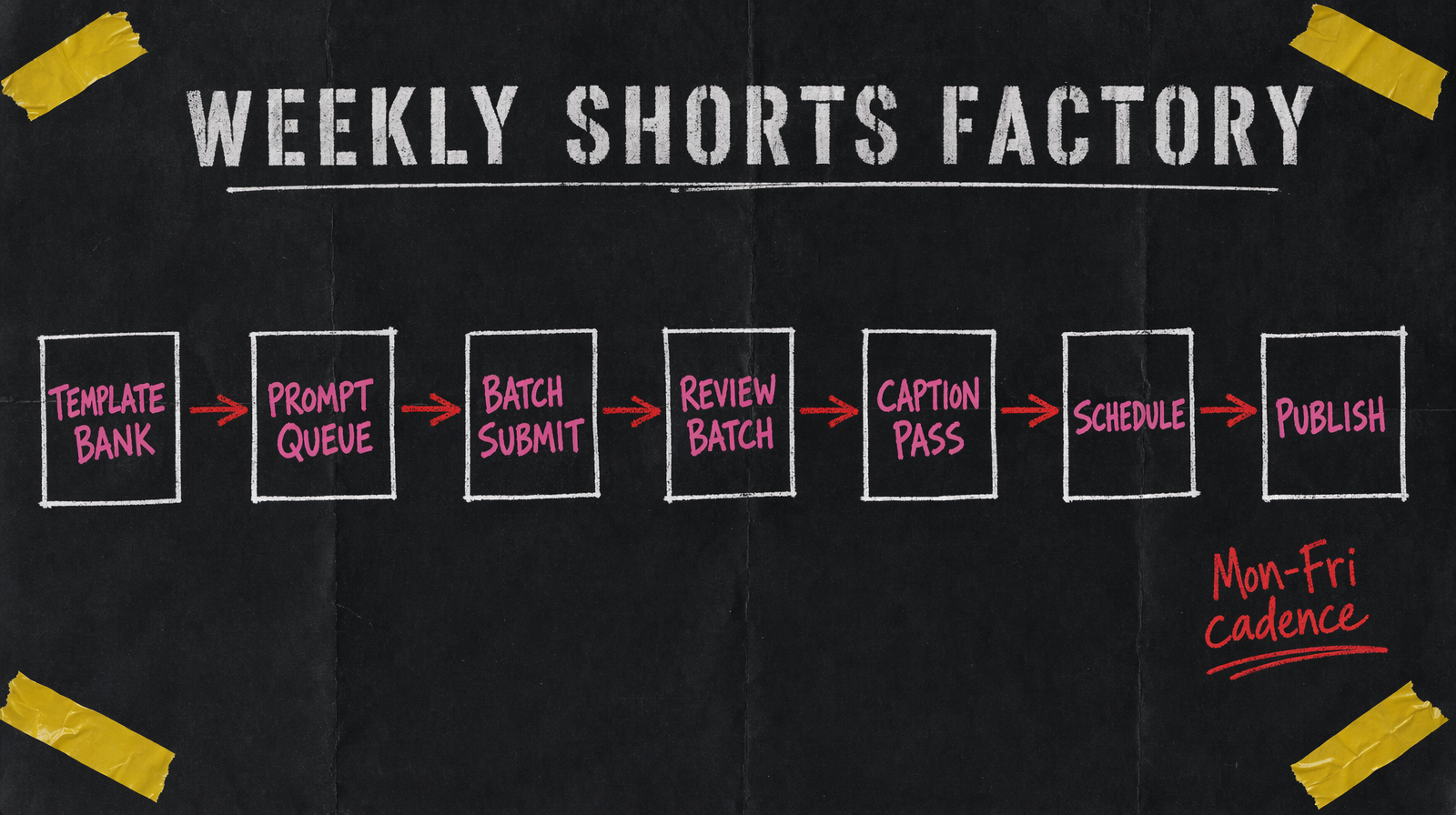
The factory stages
You want seven stages, and no work item skips a stage. Template bank produces prompts. Prompt queue holds them in order. Batch submit fires them to the model. Review batch sorts keep from reject. Caption pass adds overlays. Schedule stages the publish time. Publish pushes to each channel.
Parallelize the batch submit with queue concurrency controls. You can keep 20 generations in flight without throttling most fal endpoints. Above that you will start getting rate limited on peak hours, so pace accordingly.
Model choice by purpose
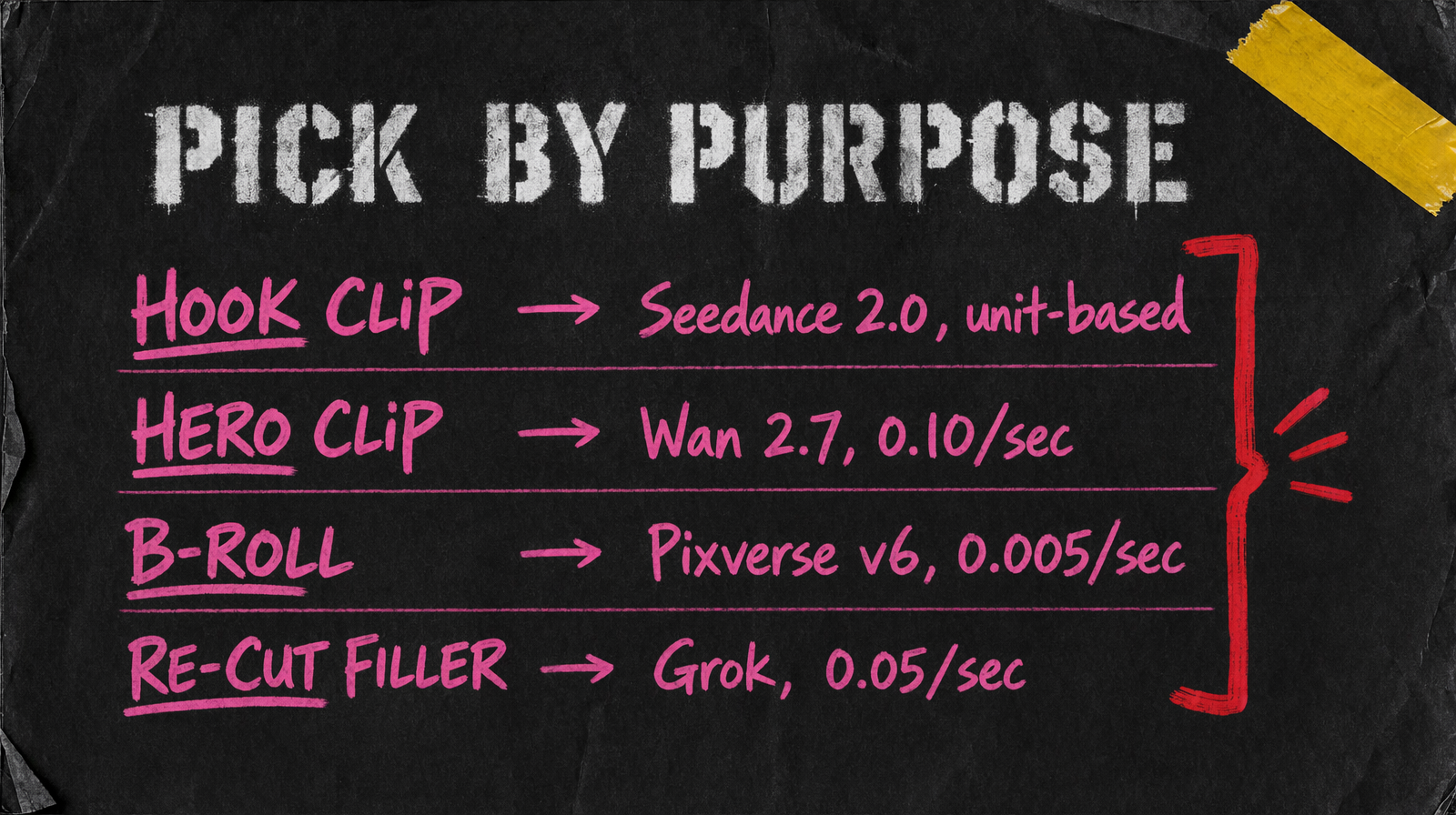
Different clips want different models. Your hook clip is the one that has to stop the scroll, so use Seedance 2.0 with unit based billing because you can generate three takes cheaply and pick the best. Your hero clip, the one the caption lives on top of, uses Wan 2.7 at $0.10 per second for the quality bump. B-roll is Pixverse v6 starting at $0.03/sec (360p no audio, scaling to $0.12/sec for 1080p with audio). When you need to recut a miss into filler, Grok at $0.05 per second is a reasonable middle.
Review at volume
The thing that breaks is review. 100 clips a week with a 20 percent reject rate is 20 reviews and 20 regenerations, which is 40 individual review events. Keep the loop tight. Structure review as a batched session twice a day, not a trickle. Review 20 at a time on a grid view. Pass or reject, no "revise the prompt a little". If you want to revise, that is a new work item in the template bank next week.
Cost at 100 a week
Assume an average short uses one hero clip (6s Wan 2.7 = $0.60), two b-rolls (3s each Pixverse at 360p no audio = $0.18 total at 2 x 3 x $0.03), and one hook (Seedance unit billing, roughly $0.40 for three takes). That is around $1.18 per published short plus about 20 percent waste on rejected generations. At 100 a week you are looking at roughly $140 in generation cost. Most teams burn more than that in a single stock footage subscription with fewer clips.
Common failure mode
Quality creep. You start with high quality prompts, and over four weeks the templates get copied, edited, and diluted. By week five your shorts look generic. Fix it by versioning your templates. When someone wants to change a slot, they fork the template, bump the version, and the old one still exists. You also run a monthly review where you cut the three weakest templates from the bank and commission two new ones.
Volume works when the work is repetitive and the template is sharp. If either breaks the pipeline drifts. Keep the discipline and 100 a week is a Tuesday.