Meme and Viral Loop Design: Short, Captioned, Hook-First
What makes AI video loops actually land on socials. Structure, caption discipline, and the three-second hook.
Meme and Viral Loop Design: Short, Captioned, Hook-First
A viral loop is a specific format. 3 to 7 seconds. Loops cleanly. Has a caption that hits in the first second. The loop itself has a hook, a beat, and a payoff, in that order. Miss any of those and you have a clip nobody watches twice.
AI video is really good at this format once you stop treating it like short form narrative. It is not narrative. It is a single joke or moment, designed to be watched in a feed between other content.
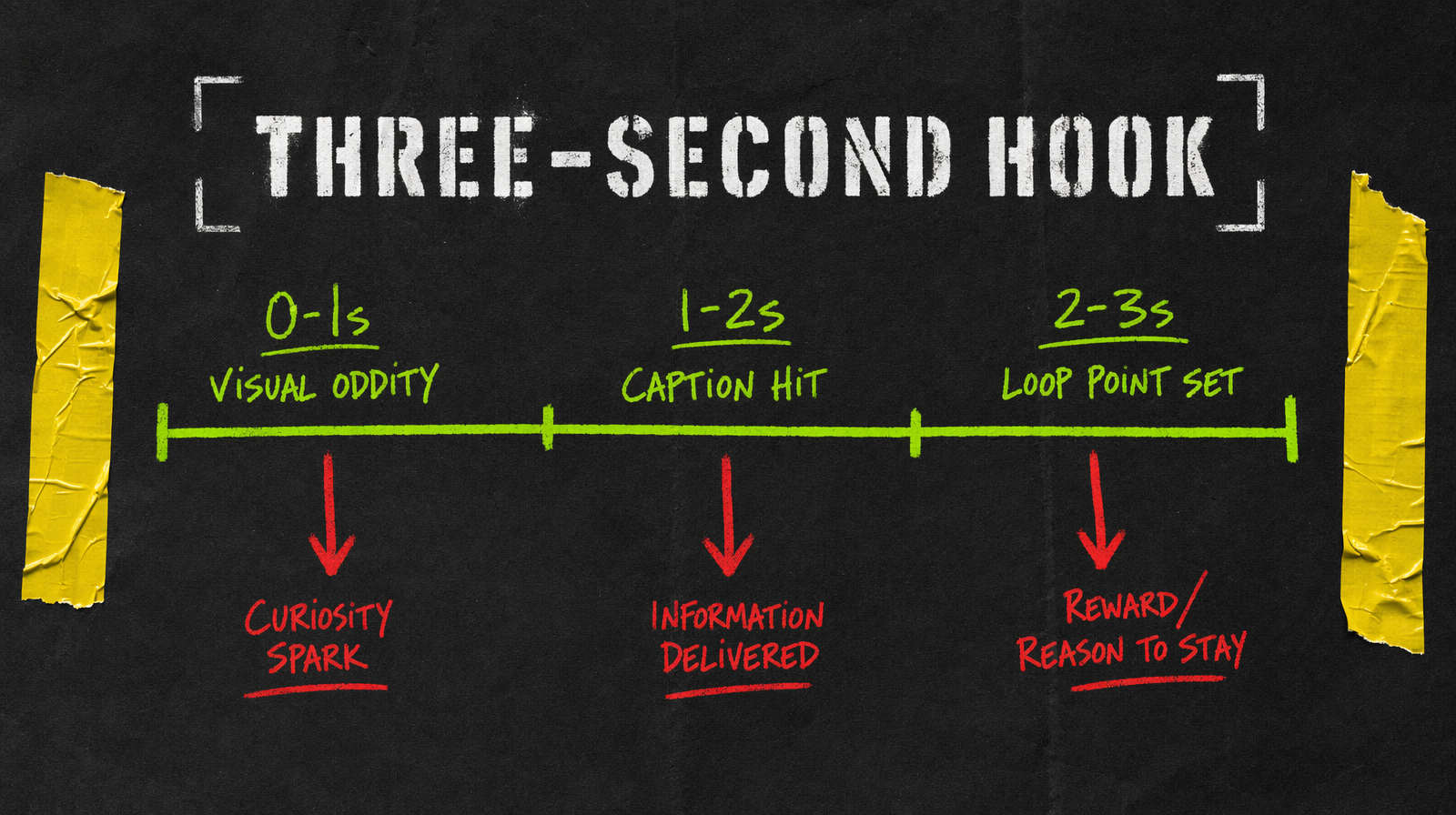
The three second hook
Everything happens fast. Zero to one second, you need a visual oddity. Something that makes the thumb stop scrolling. Could be a color, a juxtaposition, a character in a situation that is off.
One to two seconds, your caption hits. Overlay text, not generated. The caption sets up the joke or the payoff.
Two to three seconds, you set the loop point. The thing that happens at the three second mark should be possible to play from the start without a jarring transition.
Loop design tricks
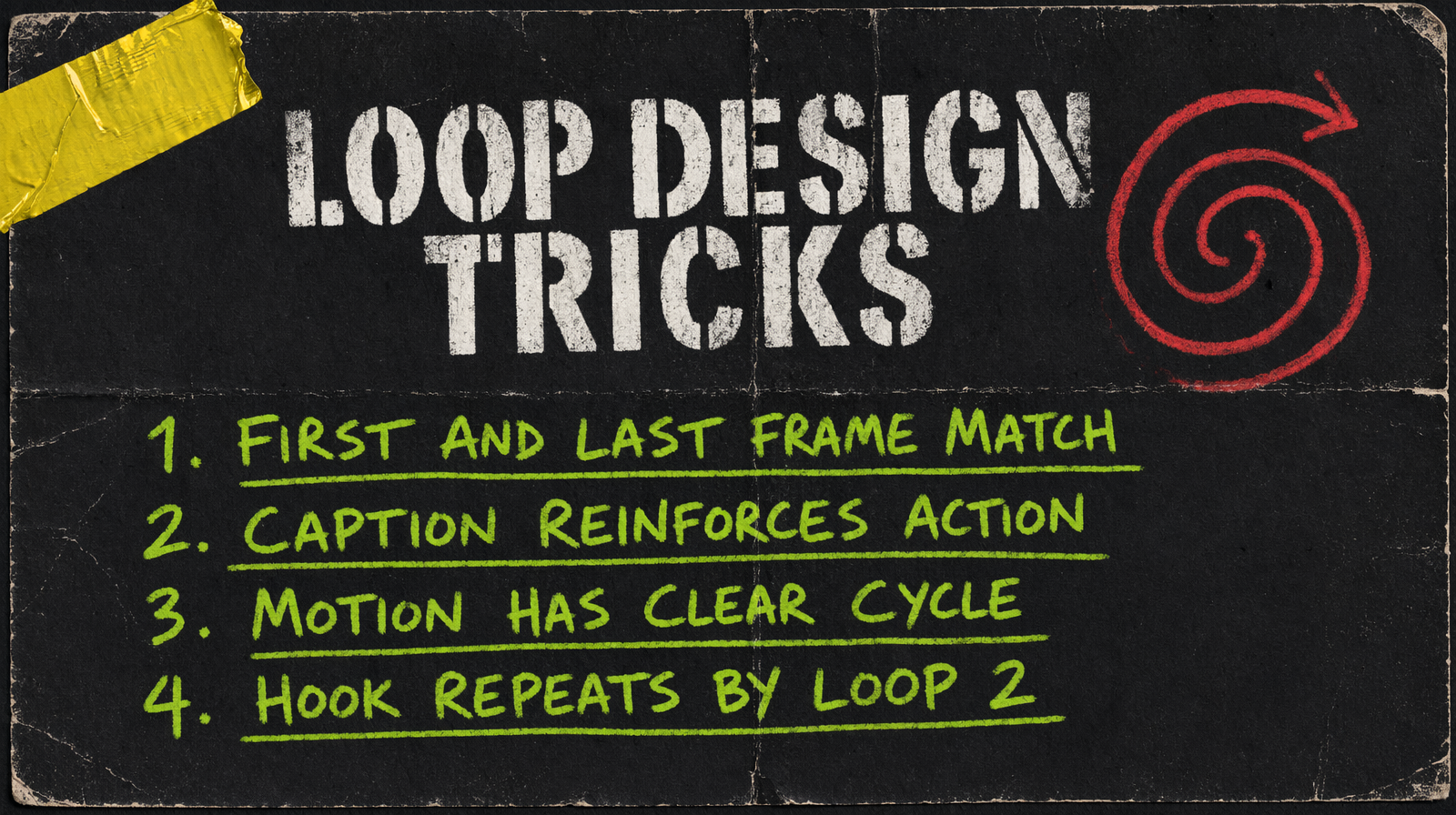
Four patterns work reliably.
First, match your first and last frame. Not pixel perfect, but compositionally close. Same framing, similar lighting, a subject in roughly the same position. The eye accepts a cut between similar frames as a continuation.
Second, your caption reinforces the visual action, not the other way around. The visual should still be funny muted. The caption is the punchline or the subversion.
Third, the motion has a clear cycle. A cat blinking. A character walking into frame and out. A cup being raised. Actions with an obvious start and end loop better than arbitrary motion.
Fourth, your hook repeats by the second loop. Viewers who watch twice are checking whether they saw what they thought they saw. Reward that check.
Model picks for loops
Pixverse v6 starting at $0.03/sec (360p no audio, scaling to $0.12/sec for 1080p with audio) is the default. Loops at 4 seconds cost around $0.12 each at the 360p no audio tier. Generate ten variants and pick the one that loops cleanest.
Seedance 2.0 with unit based billing is the choice when you want better quality on a loop and you need multiple takes. The unit billing is forgiving when you generate 4 takes of the same idea.
Wan 2.7 at $0.10 per second is for the hero loop in a campaign. The one you will put actual media dollars behind.
Grok at $0.05 per second handles absurdist or surreal looping content surprisingly well. When your concept is weird, Grok is a reasonable pick.
Prompting patterns for memes
Two things separate meme prompts from regular prompts.
You prompt for the moment, not the story. "A pigeon wearing a tiny business suit, walking confidently toward the camera on a sidewalk, stopping abruptly, tilting head". That is a meme prompt. It is specific, has a clear action beat, and the weird detail is loaded at the front.
You accept imperfection. Meme content does not need to be photorealistic. Slight model oddities often help. A subtle uncanny detail is part of the charm.
Cost and volume
Meme content is a volume game. Assume 10 to 20 percent of your generations will become posts. Budget 5x what you plan to publish.
At Pixverse pricing, a week of meme content with 25 published posts might need 125 generations at 4 seconds each, total around $15 at the 360p cheapest tier. That is trivial cost for a week of social output.
Common failure mode
The failure is trying to be narrative. Meme content is not a story, it is an observation. When you write a prompt that describes a scene evolving, the model produces 4 seconds of evolution that does not loop and does not land. Write prompts for a moment.
The other failure is burning captions into the generation. Models render text badly, and you lose the ability to A/B different captions on the same clip. Always overlay in post.