Marketing Shorts Pipeline: Concept to Published in an Hour
A complete marketing workflow using Shorts Studio plus Seedance. Approval gates, caption rules, export specs.
Marketing Shorts Pipeline: Concept to Published in an Hour
Every marketing team asks the same question about AI video. "How do we take a brief at 9 and have a captioned short going live by 10?" Good news, it is not a fantasy. Bad news, the honest answer requires thinking about it as a pipeline, not a single call.
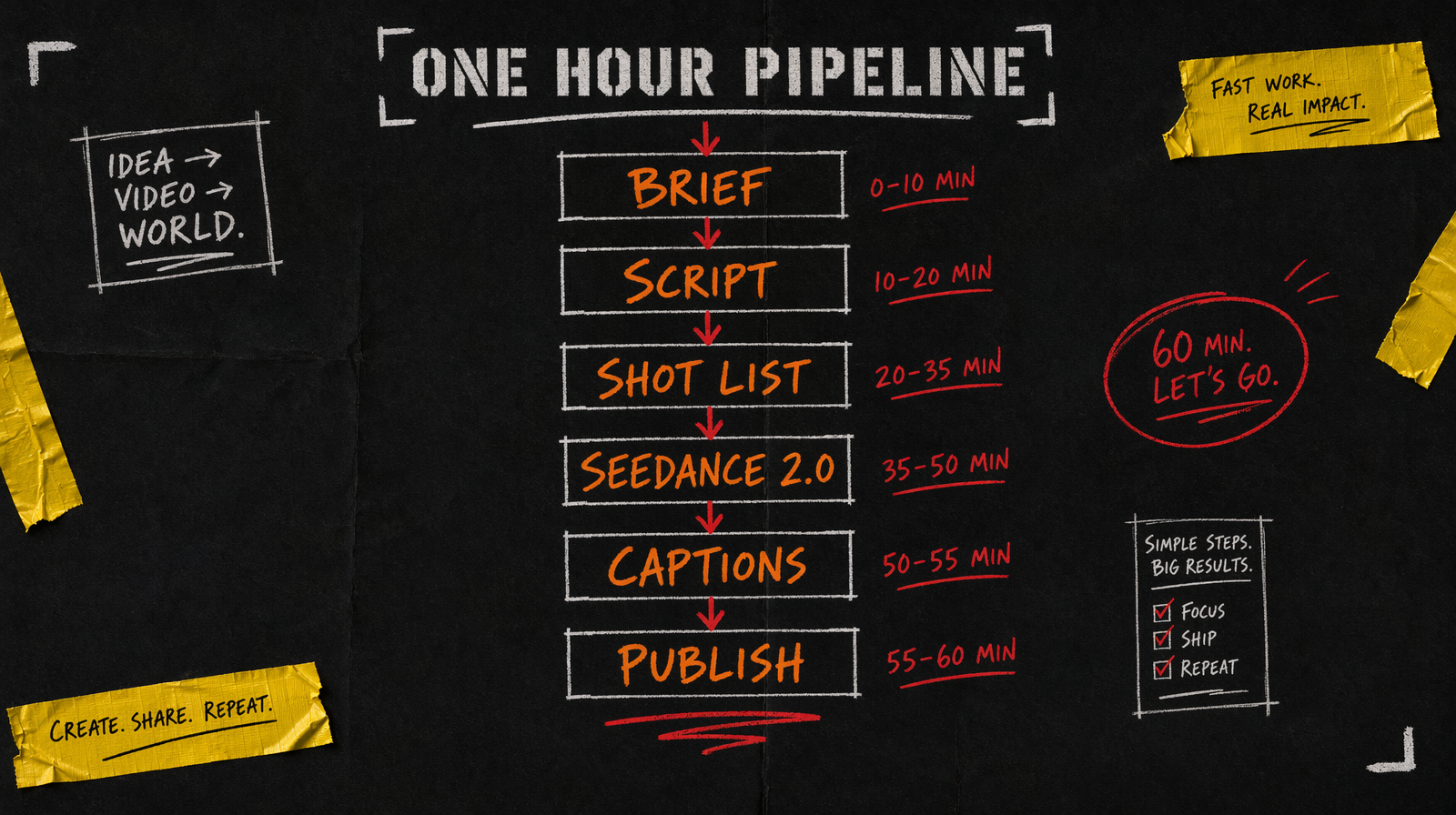
Here is the shape that works. You stage a brief, a script, a shot list, a generation pass, a caption pass, and a publish pass. Six stages, one hour budget, zero heroic effort.
The stack you want
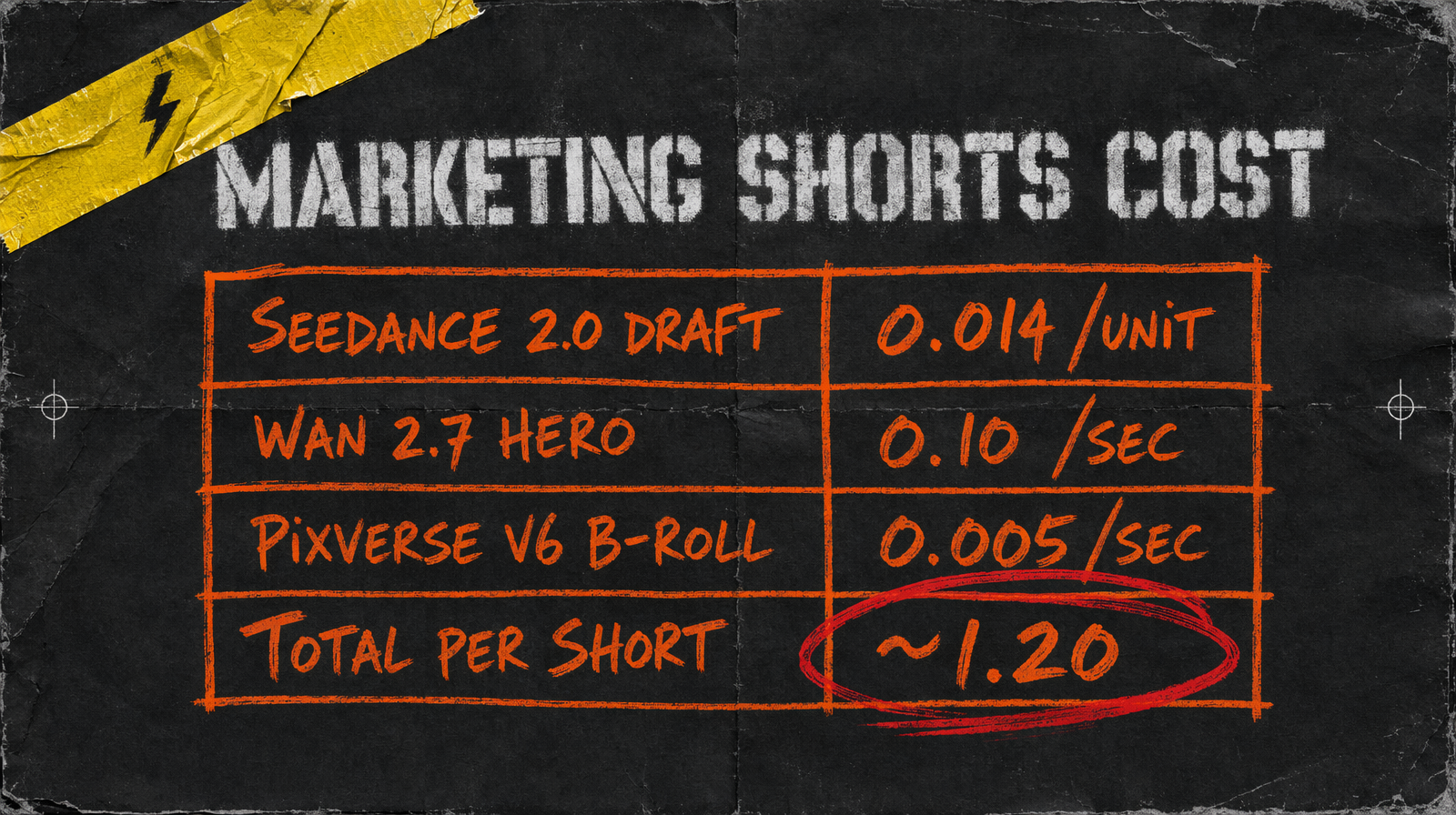
You want three generation models and one orchestrator. For the draft pass use Seedance 2.0 at $0.014 per unit because the unit based pricing means you can generate cheap iterations before you commit. For a hero clip where quality matters use Wan 2.7 at $0.10 per second with prompt expansion on. For cheap b-roll fill use Pixverse v6 starting at $0.03/sec (360p no audio, scaling to $0.12/sec for 1080p with audio).
Keep durations short. Most of the b-roll is 3 to 4 seconds. Hero clips sit at 6 seconds. Anything longer and you are burning budget on frames nobody will watch.
Prompting patterns that ship
Write shot prompts in the same structure every time. Subject, motion verb, location, lighting, camera move. Five beats. When you keep the structure the same, your pipeline can template the format programmatically and the models stay predictable across a campaign.
Lock seeds when you find a look you want. Seed locking does not reproduce the clip pixel for pixel, but it keeps the visual language within the family. That matters when you publish five shorts in a week and want them to feel like the same campaign.
For captions, do not ask the model to burn them in. Generate clean video, caption in post. You get to A/B caption copy without regenerating. Iteration cost drops by about an order of magnitude.
Cost per published short
A typical 40 second short with one hero clip, three b-roll pieces, and an outro card lands around $1 to $2 in generation cost. Most of the cost is the hero. Most of the iteration is the b-roll, because a hero clip you generate once and cut around, while b-roll you generate twice and pick the better take.
Common failure mode
The one failure pattern to watch is the "too long" clip. You brief a 6 second hero and get a 5 second version that does not loop cleanly. Fix by sizing every prompt to one beat below what you think you need. Trim in the edit if too short is better than stretch. Models cannot stretch, you always can.
The other pattern is caption drift when prompt expansion rewrites your brief. If you tell Wan 2.7 "minimalist studio lighting" and prompt expansion adds "cinematic golden hour", the caption copy stops matching the look. Log the expanded prompt on every generation, lock it on the hero, and your caption copy stays honest.
What a published hour looks like
You spend 10 minutes on the brief and script. You spend 15 minutes writing shot prompts from a template. You submit the batch and do something else for 8 minutes while the queue works. You review in 12 minutes, kick back two prompts, regenerate, and cut the piece together in 15 minutes. That is 60. You hit it consistently by refusing to let any one stage sprawl.
The pipeline is not magic. It is discipline applied to cheap generation. Lock your template, keep clips short, pick models by purpose, and publish.