Which fal.ai Models Ship with Native Audio
Five models generate audio in the same pass. The audio quality gap between them is bigger than the video quality gap.
The verdict up front
Five fal.ai video models generate audio in the same pass as the video: Veo 3.1, Veo 3.1 Fast, Kling v3 Pro, Kling v2.6 Pro, LTX 2.3, and Grok Imagine. Seedance 2.0 also ships native audio. The audio quality gap between them is wider than the video quality gap. Veo 3.1 is the only model where lip-sync dialogue is reliably production-ready. The rest range from good ambient to decent SFX to usable-with-mixing.
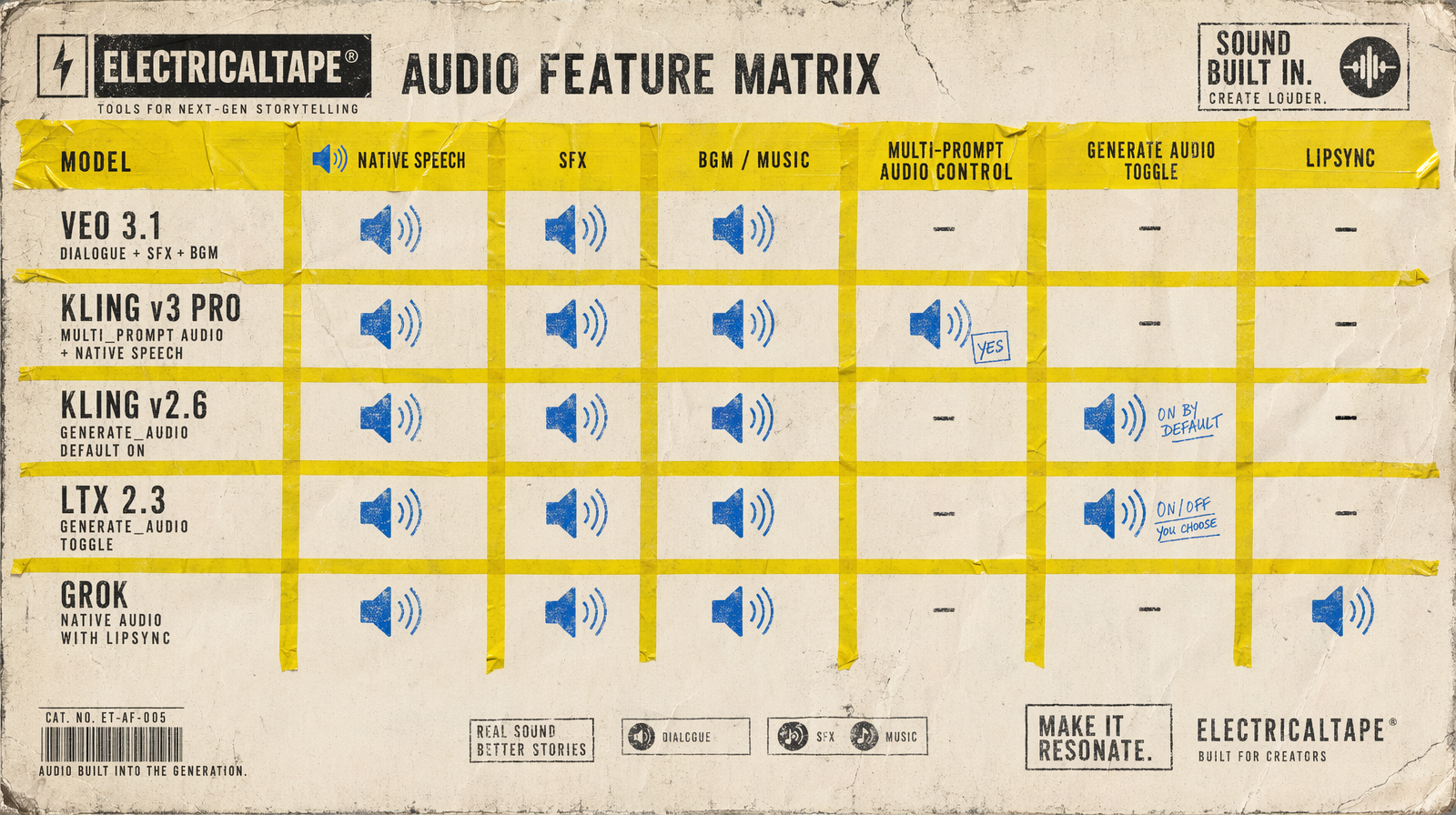
The audio capability table
| Model | generate_audio default | Dialogue | SFX | BGM | Lip sync |
|---|---|---|---|---|---|
| Veo 3.1 | true | yes, scripted | yes, environmental | yes | production-ready |
| Veo 3.1 Fast | true | yes, scripted | yes | yes | good |
| Kling v3 Pro | true | yes, Chinese and English | yes | yes | good |
| Kling v2.6 Pro | true | yes | yes | yes | acceptable |
| LTX 2.3 | true | no scripted dialogue | yes | yes | not the use case |
| Seedance 2.0 | true, cannot disable pricing | yes, lip-synced | yes, ambient | yes | good |
| Grok Imagine | native with lipsync | yes | yes | yes | good |
| Wan 2.7 | audio_url drives, does not synthesize | no | no | model writes BGM if no audio_url | no |
| Pixverse v6 / C1 | false by default | opt-in | opt-in | opt-in | limited |
Wan 2.7 is the outlier. It has an audio_url parameter but it does not synthesize audio. You pass a WAV or MP3 and Wan drives video motion to match. If you skip the URL, Wan writes background music to match the video, but it will not speak a dialogue line.
The five real contenders
If your goal is a video with audio in one call and no post-production mixing, you are choosing between Veo 3.1, Kling v3 Pro, LTX 2.3, Seedance 2.0, and Grok Imagine. The ranking depends on what you need the audio to do.

Scripted dialogue with lip sync
Veo 3.1 wins clearly. You write a line in quotes, the model speaks it with matched lip movement. At $0.40 per second it is the expensive option, but it is the only one you can ship to a client without re-recording the line.
Kling v3 Pro is second. Its generate_audio supports Chinese and English voice output. Other languages translate to English. For a branded line, Kling handles it but the voice is less controllable than Veo.
Seedance 2.0 supports lip-synced speech and the cost structure (per-unit at $0.014) makes it the cheapest way to get dialogue on-screen. Voice quality is closer to UGC than broadcast.
Environmental ambient and foley
All five models do this. The gap narrows. LTX 2.3 is surprisingly strong here. Specific foley cues like ceramic mug on wood or match striking against sandpaper render with enough specificity to skip a foley pass.
Veo 3.1 still edges out on acoustic space. reverberant concrete garage versus dampened hotel corridor produces genuinely different reverb signatures.
Background music
Every model scores decent BGM, but you almost always want to strip it and replace with licensed music. If you are shipping for a client, you cannot use model-generated music because rights are murky. Set generate_audio: false or its equivalent, or use no music in the prompt for models that read that cue.
Veo 3.1 reads no music as a real instruction. Kling v3 Pro does too. Seedance does not; it will still bed the video in something.
What this means for your pipeline
For hero dialogue shots, pay for Veo 3.1. For multi-shot narrative with spoken lines, Kling v3 Pro's multi_prompt plus its audio model is the combo. For social UGC with ambient sound, Seedance 2.0 per-unit pricing makes it the default. For cinematic B-roll with specific foley, LTX 2.3 at $0.08 per second is the value play.
Do not pick a video model first and then ask whether the audio is good enough. Pick the audio use case first, then pick the model that fits.