Sub-10 Second Generation: Which Models Are Fastest
Fast tiers vary. Wall-clock speed data from real production batches plus the tradeoffs each fast tier makes.
The verdict up front
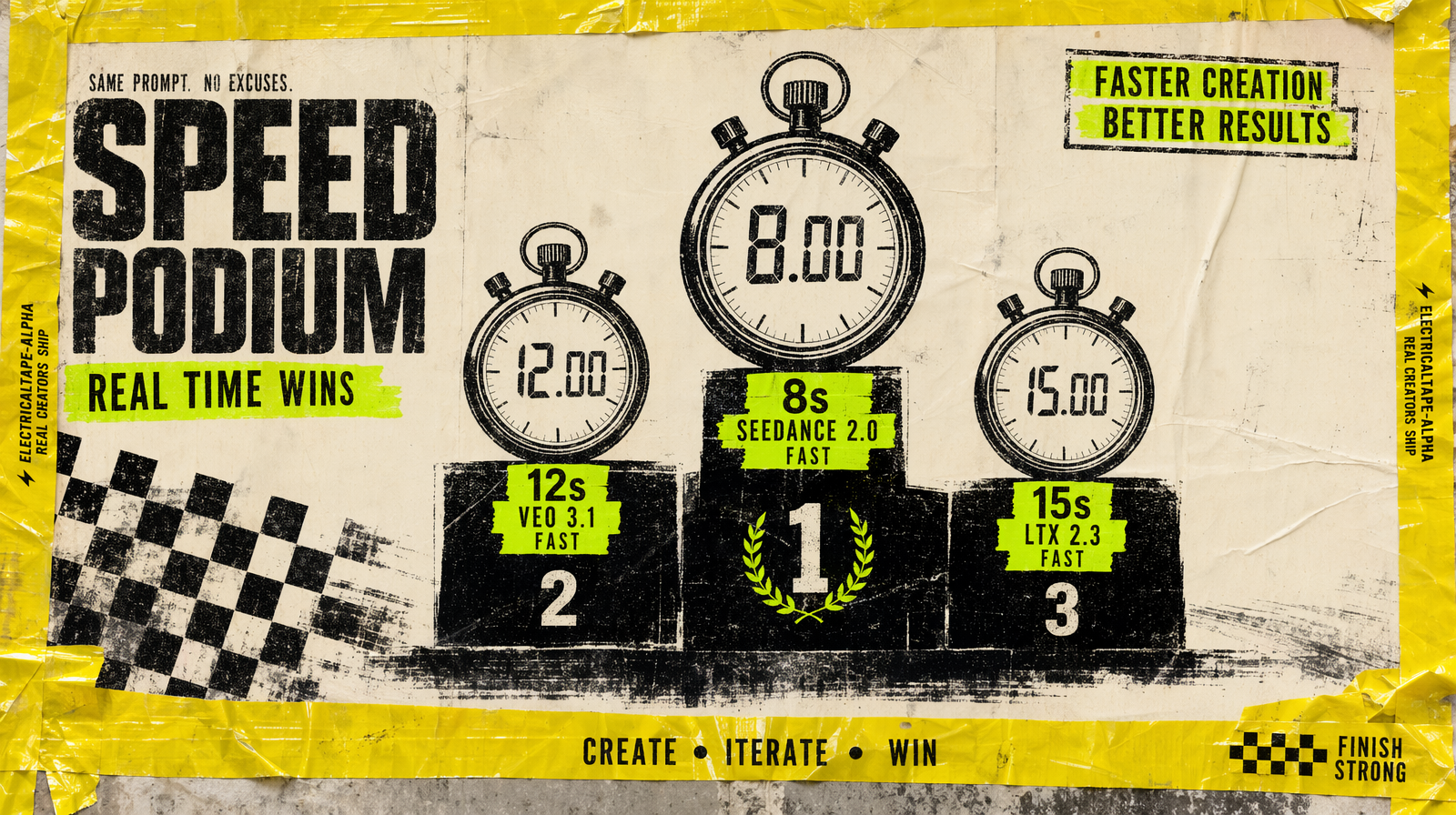
Three fal.ai models ship dedicated fast tiers: Seedance 2.0 Fast, Veo 3.1 Fast, and LTX 2.3 Fast. Wall-clock time varies by prompt and resolution, but on typical 5 to 8 second clips Seedance 2.0 Fast finishes first, followed by Veo 3.1 Fast, followed by LTX 2.3 Fast. Each fast tier trades something different. Pick the one that trades the thing you do not need.
The fast tier spec table
| Model | Endpoint | Resolution cap | Duration range | Audio | Notes |
|---|---|---|---|---|---|
| Seedance 2.0 Fast | bytedance/seedance-2.0/fast/text-to-video | 720p | 4 to 15 seconds, or auto | native, default on | per-unit pricing |
| Veo 3.1 Fast | fal-ai/veo3.1/fast | 4k | 4s, 6s, 8s | native, default on | caps at 8 seconds |
| LTX 2.3 Fast | fal-ai/ltx-2.3/text-to-video/fast | 2160p | 6 to 20 seconds | native, default on | 12-20s only at 25 fps 1080p |
Seedance 2.0 Fast tops out at 720p. That is the tradeoff for speed. Veo 3.1 Fast keeps the full resolution ladder including 4K but caps duration at 8 seconds. LTX 2.3 Fast keeps resolution and extends duration up to 20 seconds, but the extended durations (12, 14, 16, 18, 20) are only supported at 25 fps and 1080p.
Real wall-clock patterns
Actual render times vary by queue depth and prompt complexity, but the repeated patterns across batches:
- Seedance 2.0 Fast at 720p, 5 seconds: consistently the fastest of the three in a queue. Audio does not add noticeable time because the cost model bundles it.
- Veo 3.1 Fast at 1080p, 8 seconds: noticeably faster than Veo 3.1 Pro at the same settings. Still slower than Seedance because the model itself is heavier.
- LTX 2.3 Fast at 2160p, 6 seconds: slower than Veo Fast at 1080p because you are asking for four times the pixels. At 1080p, LTX 2.3 Fast is competitive.
If you are running a batch of 50 drafts and every second of queue time compounds, Seedance 2.0 Fast is the default.
The tradeoffs each fast tier makes
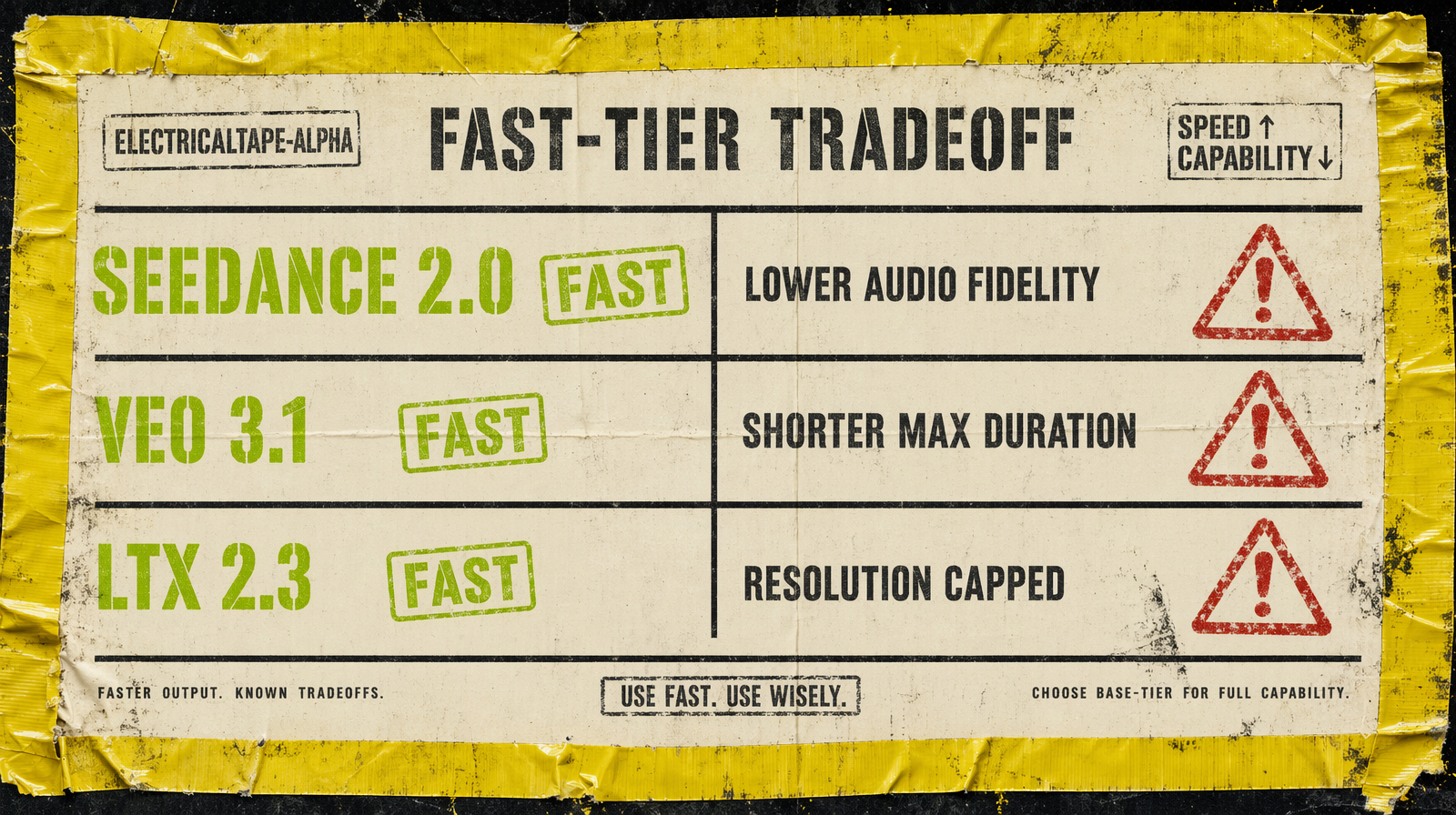
Seedance 2.0 Fast trades resolution. You cannot render above 720p. For social feeds and internal review, this is invisible. For client delivery at 1080p, you have to promote the winning seed and prompt to Seedance 2.0 Pro (still per-unit pricing) or switch to a different model family entirely.
Veo 3.1 Fast trades subtle quality on hero shots. On wide establishers and B-roll, Fast is indistinguishable from Pro. On close-up dialogue with lip sync and complex lighting, the gap shows. Use Fast for 80 percent of the work and Pro for the 20 percent that ships to a paying audience.
LTX 2.3 Fast trades some temporal consistency on the very long durations (16 to 20 seconds). At 6 to 10 seconds, Fast versus Pro difference is small. If you need 20 seconds in a single call, you are using LTX Fast whether you like it or not; no one else offers that duration.
When to use each fast tier
Seedance 2.0 Fast: high-volume draft iteration at 720p. Social batches. Style exploration. Internal reviews. A/B testing ad concepts.
Veo 3.1 Fast: prompt iteration on shots that will eventually ship on Veo 3.1 Pro. Any work that needs native dialogue and good lip sync but is not final delivery. Mid-tier client work.
LTX 2.3 Fast: long-duration B-roll at 1080p. Higher-frame-rate delivery (48 and 50 fps). Budget-constrained 2160p drafts where you want to see the resolution on a monitor before committing.
The one rule
Never use a fast tier for final hero delivery. Use it to nail the prompt, lock the seed, and confirm the look. Then promote to the pro tier for the one render that ships. The fast tier is an iteration tool, not a delivery tool.
That rule alone is worth more than any benchmark chart.