Seedance 1.0 Pro vs Seedance 2.0: What Actually Changed
Same family, very different pricing model. Unit-based billing changed what you do on the draft pass.
The verdict up front
If you are still running Seedance 1.0 Pro in production, port to Seedance 2.0 now. The pricing model changed from per-second to per-unit at $0.014 per unit, and that single change means your draft loops should look completely different. The quality floor went up, audio is native, and the duration ceiling is now 15 seconds instead of 12.
What actually moved
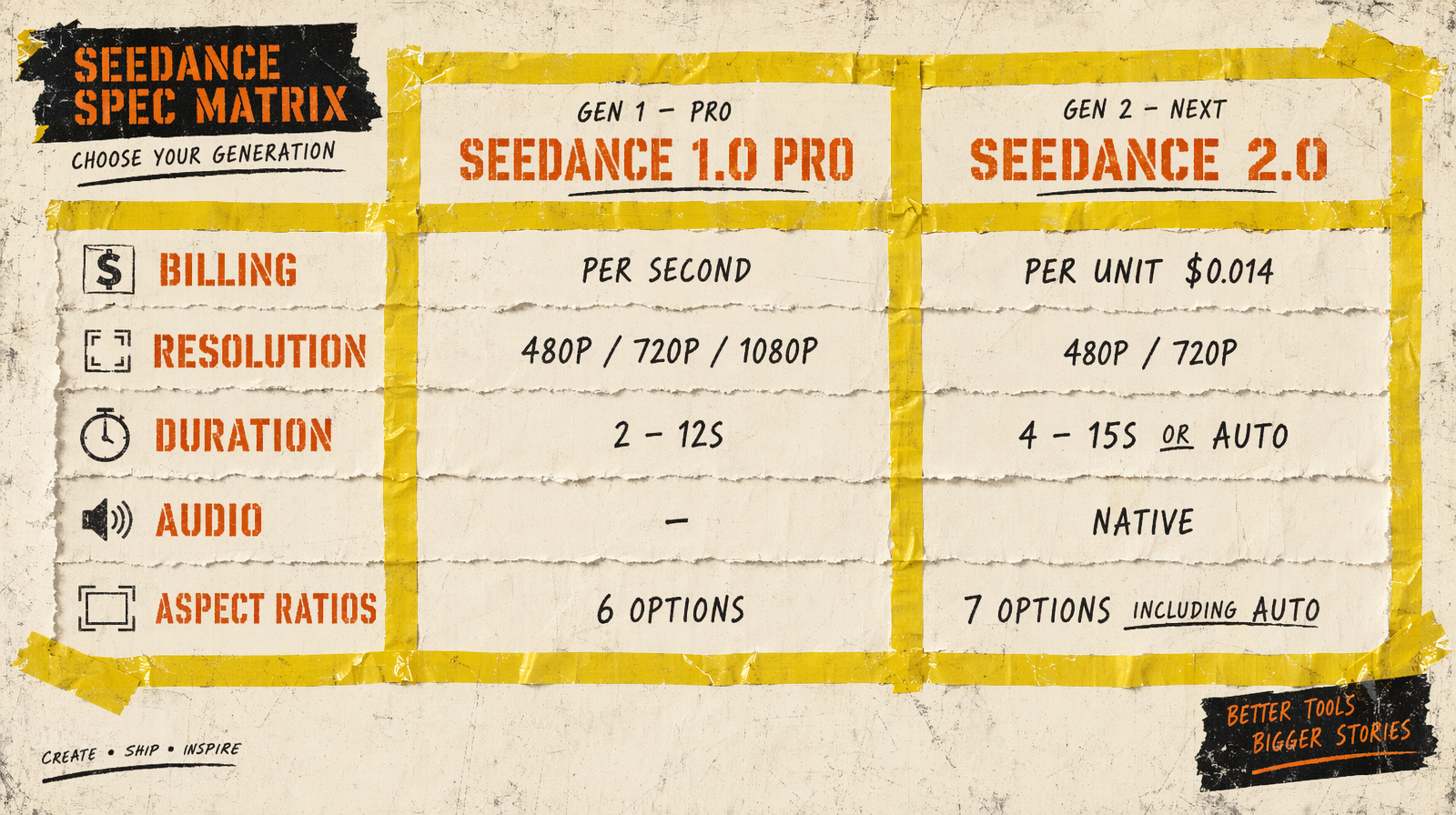
Seedance 1.0 Pro bills per second of output. You choose a resolution (480p, 720p, or 1080p), a duration from 2 to 12 seconds, and pay a flat per-second rate. Seedance 2.0 bills per unit at $0.014, where a unit is a function of resolution and frames. In practice, a 5-second 720p clip lands somewhere near $0.07, and a short 480p draft lands well below that.
Seedance 2.0 also drops the 1080p option. Your ceiling is now 720p. The tradeoff is that audio generation is native and on by default, with synchronized sound effects, ambient beds, and lip-synced speech. You cannot pay for audio to be off, because the cost is the same either way.
Spec comparison from MCP
| Parameter | Seedance 1.0 Pro | Seedance 2.0 |
|---|---|---|
| Endpoint | fal-ai/bytedance/seedance/v1/pro/text-to-video | bytedance/seedance-2.0/text-to-video |
| Billing | per second | per unit, $0.014 |
| Resolution options | 480p, 720p, 1080p | 480p, 720p |
| Default resolution | 1080p | 720p |
| Duration options | 2 to 12 seconds | 4 to 15 seconds, or auto |
| Default duration | 5 | auto |
| Aspect ratio options | 21:9, 16:9, 4:3, 1:1, 3:4, 9:16 | auto, 21:9, 16:9, 4:3, 1:1, 3:4, 9:16 |
| Native audio | no | yes, on by default |
| camera_fixed flag | yes | removed |
| num_frames override | yes | removed |
| end_user_id | no | yes |
The camera_fixed and num_frames fields are gone. If your pipeline set either, remove them before you migrate, otherwise you get a validation error.
Why unit pricing reshapes your draft pass
With per-second billing on 1.0 Pro, every iteration cost the same as the final. You either ran drafts at 480p to save money, or you accepted that 30 iterations of a 5s 1080p clip would run you real money. The math punished exploration.
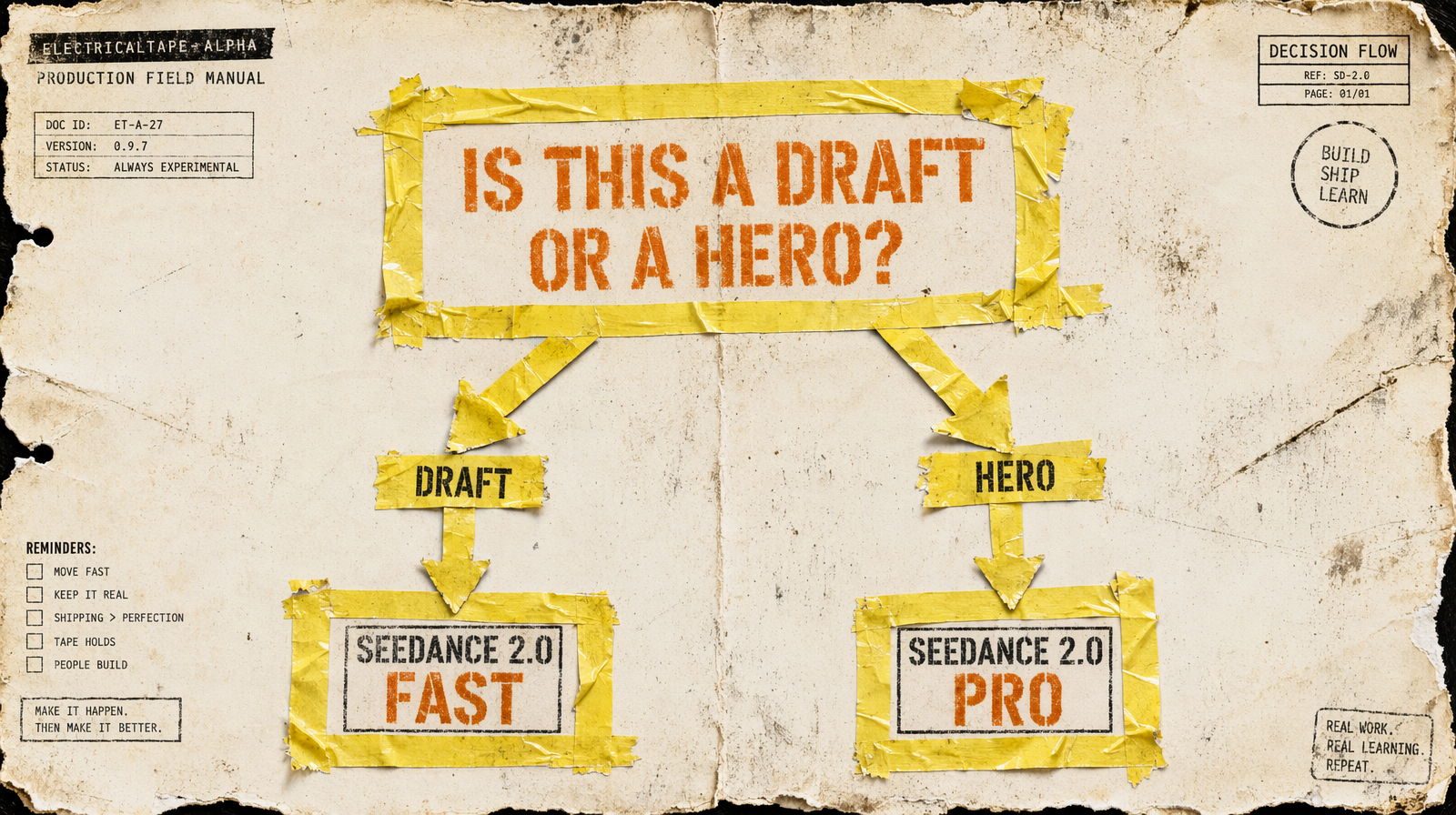
Per-unit billing at 720p changes the shape. You can iterate at the same resolution as your final, because the unit cost is low enough that 50 drafts are a rounding error. You stop building a two-stage pipeline (draft on 480p, hero on 1080p) and collapse it to one.
What to port and what to rethink
Port as-is: prompt text, aspect ratio, seed values, safety checker flag.
Rethink: the resolution tiering. You no longer have 1080p. If your delivery spec requires it, Seedance 2.0 is not your model. Look at Wan 2.7 or Kling v3 Pro.
Rethink: the duration handling. Auto is the new default, and for narrative work it produces better timing than forcing a number. If you always pass duration: 5 out of habit, try auto on your next batch and compare.
Rethink: your audio pipeline. If you were adding SFX and dialogue in post for 1.0 Pro output, check whether Seedance 2.0 native audio is good enough to skip that stage. On sound-design-heavy spots it is not; on UGC-style social it usually is.
Drop: any code that references camera_fixed or num_frames. They do not exist on 2.0.
When to stay on 1.0 Pro
Only if you need 1080p. That is the one hard constraint 2.0 cannot meet. Even then, the right answer is usually to switch models entirely rather than keep an old Seedance in production. Wan 2.7 at $0.10 per second delivers 1080p with audio-driven video. Veo 3.1 Lite at $0.05 per second delivers 1080p with native dialogue.
1.0 Pro is now the legacy path. 2.0 is where new work belongs.